.

Showing posts with label school. Show all posts

Thursday, November 10, 2011

A 'normal' day as an American Teacher in IES Complutense

One of the first things I learned is that there is almost no such thing as a normal school day, let alone a normal week. I think we've had one complete week of school so far this year. The weeks are interrupted mainly by holidays, with a couple of strikes still happening occasionally. But setting those regular 'exceptions' aside, this is how a typical day is for me (and the two other teachers at my school).

I need to be at the school between 815 and 10 AM, depending on when I have my first class. If I do have class at 815, then I should show up at 810 at the earliest, because getting to school any earlier pretty much guarantees that you will see the school deserted. The students aren't allowed in the building until 810 anyway, and even though the bell rings at 815, there is a leeway of time for the teachers to get to class (most arrive around 817, but really you have until 820 before it's kind of late).

During the school day there is only one official class break from 1055 to 1120. This isn't a luch break (because 25 minutes is entirely too short to actually have lunch :). But in practice many students eat.

The class structure seems somewhat predictable, but there are less student activities than I remember having when I was in middle school. Well, in some of my classes. I remember doing more projects. But in my middle school, I had the same classes every day. Here, some teachers only see the students once or twice a week. The only classes that students have every day are English and maybe Math. So it is a lot harder to cover the same amount of material and still do activities if you only see the students three days a week instead of five. It's a strange system, but it is what it is.

In my school, we are lucky enough to have a fantastic coordinator (José-Luis) who understands the importance of actual coordination, so we have two coordinating meetings a week: one meeting with all of the CLIL teachers (Content Learning In Lanugage...? it's the teachers who teach their subjects in English), and one meeting with all of the Americans with just José-Luis. There are three American teachers and one American auxiliare at our school. These meetings are necessary because it makes it easier to brainstorm solutions to common problems.

Each of the Americans work with several teachers. However, as we have a specialty, we each have one main teacher that we work with. We all have time set aside each week in which we can help plan out the lessons. In my case, Irene and I schedule out what topics are going to be taught on what days, and then I pick the days and topics that I think would be fun to teach. Sometimes we decide that we need to spend the day doing some sort of activity, and then I usually volunteer to research and find something because that leaves Irene free to spend more time with her other classes. Irene lets me know exactly what material she needs covered and what parts she wants emphasized. This makes my life much easier because then I don't have to worry about Irene having to go back and re-teach what I taught because I did it wrong.

I finish with the day between 115 and 305 every day, and then I go home and am done with the teaching part of my day. The work day is sufficient for me to complete all of my lesson planning (such as it is) and the English department has been very welcoming. It is a fun office to have as a base.

From talking with some of the other teachers here, Complutense is by far one of the best to work with. The staff has been welcoming of all of our input and it has a very colaborative feel. I understand that for many of the other teachers they act as a language assistant or spend a good portion of their day in PE, and their schedule is designed to keep them at school whether they have a teacher they are working with or not. But I think the situations in the other schools stems from the fact that the coordinators there think that is what they are supposed to do (and maybe it is). Here at IES Complutense we are treated as if we belong, and I like that.

Let me know if you have any questions about anything!

Sunday, October 2, 2011

IES Complutense

I work at a secondary school called IES Complutense. It is a bilingual school. Right now, only the 1st and 2nd years (1° ESO and 2° ESO). They are the 12 and 13 year-olds. Each grade is divided into several classes, lettered A-F. 1°A, 1°B, 2°A, and 2°B are all in the bilingual section, which means that they take all of their classes, except math and Spanish, in English. Every group takes English, and all classes take some classes in English. For the non-section classes, they take art and/or PE in English (since you can understand what to do in the class even if you don't understand the language).

One major difference between schools here and the US is that the students stay in the same room with the same students all day. The teachers move classrooms. Also, the kids don't have the same schedule every day. For example, the students only have science class three times per week, but it isn't on a MWF schedule. Some kids have it Monday, Tuesday, and Thursday. Others Tuesday, Wednesday, and Friday. The director of studies has the job of arranging the teachers schedules so that the students get a full schedule and the teachers also get time to prepare for class. It is a hard job, and it is also very complicated. School has been in for 2.5 weeks and the kinks are still getting worked out.

José-Luis is the bilingual coordinator, and he has the job of arranging the schedules of the three American teachers: me, Joey, and Steve. He has to arrange our schedules so that we are with our subject area teacher as much as we can be and still leave time for us to go help with the other subjects that are taught in English. This year, the scheduling is complicated by the fact that the government fired about 3,000 teachers in the Madrid area just before school started. They also added two more classes to the teacher's schedules and reduced teachers pay by about 5%. The biggest problem with this is that the government did not explain why they were going to do this or even warn teachers that this could be happening. They just made the cuts. So the teachers are on strike sometimes during the middle of the week. This doesn't mean the school is closed, because that is illegal. It just means that several of the teachers don't come to school and the students are combined into larger groups for other teachers to supervise, and the students don't learn any of the required material.

I finally started work last Wednesday. I work mostly with the natural sciences teacher, Irene. I teach once per week in each class (this next week I'm teaching about the individual planets in the solar system in 1°A/B and cellular nutrition in 2°A/B). I am also helping José-Luis with 1°A English twice per week and helping Marina with 1°C/D and 1°A in Art. My role is primarily that of being a native English speaker and pretending that I don't know any Spanish. My schedule still isn't finalized because things could change. José-Luis says that everything should be completely settled by the end of October. It seems funny that it takes a month and a half for things to be arranged with schedules in the school, but I'm not entirely surprised because it is a bit Spanish to be a little late with everything.

Friday, June 3, 2011

Spring Colloquium, University of Washington

Last week, I finished one big requirement for my Master's project: presenting at one colloquium for the Curriculum and Instruction department in the College of Education. Most everyone uses a tri-fold board, and this time I saw some cardboard boxes. But I didn't want to use one of those things. They are over-rated. So I decided to make a mobile.
I suspect that I am the only Masters student in the College of Ed who made a mobile for their master's project. Yeah, it probably took a lot more work than a regular ol' tri-fold, but it was way cooler. And I used hangers.

Thursday, June 2, 2011

Seek Thou First the Kingdom of God

This morning, I had the final for Plant Propagation class. A month ago the mid-term snuck up on me and I didn't study as much as I should have and unfortunately it showed in my grade. I didn't do terribly, but I definitely struggled with some of the questions. I was not going to do that again.

Yesterday between classes I went to the class website and pulled up each week's study questions that the teacher posts online going over that weeks material. I also pulled up all of my notes for the quarter to review and started into it. I got through about 3 1/2 weeks and then had to go to class. Then after class I went to the temple on an Initiatory assignment. It was great. Then I studied a little bit before I went to sleep that night (at 11, cause I'm trying to go to bed earlier so I can get up earlier). I planned on getting up this morning, showering and then reviewing it all a second time. This quarter I have been regularly working evenings and it is not unusual for me to get home around 11, get ready for bed, read a book for a bit, and then go to sleep. Because of this schedule, and because I am no good at staying up to do homework, I have gotten into the habit of finishing homework in the mornings before I leave for school. Unfortunately, during breakfast is the time I have set aside for studying the scriptures. This morning as I was getting my materials together to study and cereal in a bowl to consume, I thought, "I don't think I'll have time to read scriptures this morning. Which really is too bad, because I have been missing morning reading quite a bit recently." Then I remembered the scripture I had read last week, "Seek ye first the kingdom of God, and all these things shall be added unto you." That scripture had struck me when I first read it. I remembered feeling that if I made my callings and responsibilities to God a priority, He would ensure my ability to accomplish all other things pertinent in my life, even if I didn't have the time to get to them. They would be ADDED unto ME. I decided that I was going to first seek the kingdom of God and I knelt down and prayed that I would remember the things that I had studied yesterday, and that I would be able to focus on the scriptures as I studied them, and that I would WANT to seek the kingdom of God first, because I couldn't help but think about how I really wanted to study in order to feel more confident about the final. Then as I ate breakfast, I started back into the Gospel of Luke. It was wonderful. I was reading about parables and read through about 3 chapters. By the time I finished, it was time to pack my bag and head off to school.

I got to class in time to sit down and pull out my notes for 5 more minutes of review. When my teacher passed out the final and notes went away, I ate my way through the final like I had never seen paper before, and really wanted to know what it would feel like in my digestive track. I felt really good about it all when I finished, and didn't blank on anything. It was wonderful. I don't know how I did, but I think it is safe to assume I passed the class.

It was one of those small things that probably won't drastically change my life, but will definitely help me when it comes down to putting the Lord before everything else in my life. Is it really that important to say family prayer morning and night, even if you have to wake other people up for it? Is it important to make time to have family home evening, even if you guys do spiritual stuff together all the time? Is it important to make temple attendance a priority even if you get out about once a month just fine? Yes. Yes to it all. And if ye do, all things shall be added unto you. Opening the windows of heaven and all that.

Tuesday, November 16, 2010

Identity

I wrote this email to a teacher sharing my thoughts on the topic of Identity. We had been discussing that day what was a real Indian? In my mind this is closely tied to anyone's personal identity.

Just for reference, Blood Quantum is how much percentage someone has of a certain racial, or ethnic ancestry, particularly in reference to whether an American Indian is considered by the US government to be an American Indian.

~~~~~~~~~~~~~~~~~~~~~~~~~~~~~~~~~~~~~~~~~~~~~~~~~~~~~~~~~~~~
Elissa

Today we were talking about Indian "Identity" and I wanted to share some thoughts I'd had on the subject.
The first time I remember investigating my "heritage" was in fourth or fifth grade when we had to do a presentation on a foreign country (or culture) in our blood heritage. It was the first time I tried to track my genealogy out of the country. My family has been born in the US for about 3 or 4 generations on all sides and by the time I got people that were born in another country, it was scattered all over. I think I ended up being about 1/4th English and 1/8th Danish and then 1/16ths and 1/32 other stuff. Oh and like 1/8 Swiss, which means they were part of another country or culture when Switzerland was formed. I didn't want to do England, cause like 3 or 4 kids were already doing England, so i ended doing Switzerland. After that I don't remember thinking much about the culture my ancestors were from. This is not to discredit the culture and heritage of my parents and their parents and grandparents, but that was about as far as it went for me.

Then I got into a multicultural studies class my sophomore year in college and was one of two (three including the teacher) of white, middle class, christian males. I got the impression from the class that the accepted view of multiculturalism was that I, being of the oppressing class, would never know the hardships of those that I had oppressed, regardless of the actions of my or their ancestors. I didn't really get it and it didn't affect my relationships with any of my friends (arab, asian, african, european, american etc.) but it did expose to me the importance that many people put on race, and ethnicity. And that we do have distinct and different heritage and that that shouldn't be ignored, and that past oppression has modern day consequences and affects.

As part of my personal statement in my transfer application to the University of Washington, I was asked to include how multiculturalism has affected me and life. I didn't understand the question. Because it was much more than who am I, ancestrally (a northern European mutt), or how much money my father makes (middle class), or what schools and church I went to, and what friends I had. I had to some how comprehensively talk about it all, and it was the first time I tried to figure out how I identified myself.

Ok, here goes. I was white. Check. Little confusion about that. I had no known relatives from Africa, Asia, South America, or that were "Native Americans". I was part of the middle class, a culture all of its own (or so I'm told). My parents made a decent living and spread over 11 kids we always had enough, but we sure didn't have luxuries of cable TV and large birthday parties. I was Christian, but a special kind of Christian. One that many Christians didn't consider Christian. Some even called us a Cult. I was (and am) Mormon. That was how I primarily identified myself. I was more Mormon than I was of European decent. More than I was middle class (the church easily crosses financial lines, and thus my social circle founded therein did as well). More than I was from Seattle (and I am a Seattle-ite through and through). But this Christian subsection was hardly ever recognized in school. Never discussed in multicultural classes I had taken. The only reference I remember from K-12 education was eighth grade high-cap social studies, where someone did a vague and extremely skeptical report on the founding of the church by Joseph Smith, and how they were the primary settlers of Utah.

And so I wasn't sure how well this identity fit in with the "academic" view of multiculturalism that this question was addressing. I decided to include it and voice my opinion on the lack of history of mormons and mormon persecution in college and primary education. It being once acceptable to kill blacks because of their skin color, must be as outrageous as an extermination order passed in Missouri to kill all mormons in the state. There weren't concentration camps. Instead those that didn't escape were killed on site.

The people who endured this and pioneered to find freedom and worked hard to do so (in Utah of all places) are the people I claim to be my cultural ancestors. I've thought a lot about this cultural portion of ancestry and feel that who you define yourself as should have more impact on the way you are defined as others to be than who your parents and grandparents were and what they did. Would Bruce Wayne be a great man if he squandered his father's fortune because his father fought for social justice? No, he had to.

Anyway, I've blathered on and this is a bit disjointed, but to get down to my point, I think cultural self identification (and acting as part of those identifications, practicing what you preach) is more important than any sort of blood quantum or whatever. I understand that religious culture is a lot easier to adopt into your own life than racial or ethnic culture, but are American Ex-pats living in Britain (that want nothing to do with the United States) American? Are they British? Should it matter?

Hollis Crapo

Friday, November 12, 2010

School Fall 2010

So Michelle and I are in school right now, I in my senior year at UW and Michelle in her last year of her Masters program there as well. So I thought I would tell you about my classes. I'm taking Northwest Coastal Indian 2D art. It all about learning the shapes and forms of Coastal Indian art and involves a lot of drawing and is super fun. Its been about 8 years since I've taken an art class, and I love it. I'm taking an intro to American Indian Studies class. It's required for my AIS minor and is very laid back and broad and . . . well . . . easy. But the best class by far is Wood Carving. It's taught by the same teacher that teaches my 2D art class. He is an Indian artist that lives locally and has been teaching for years. He only teaches these two classes and teaches them both every quarter. He is also a curator at the Burke Historical Museum.

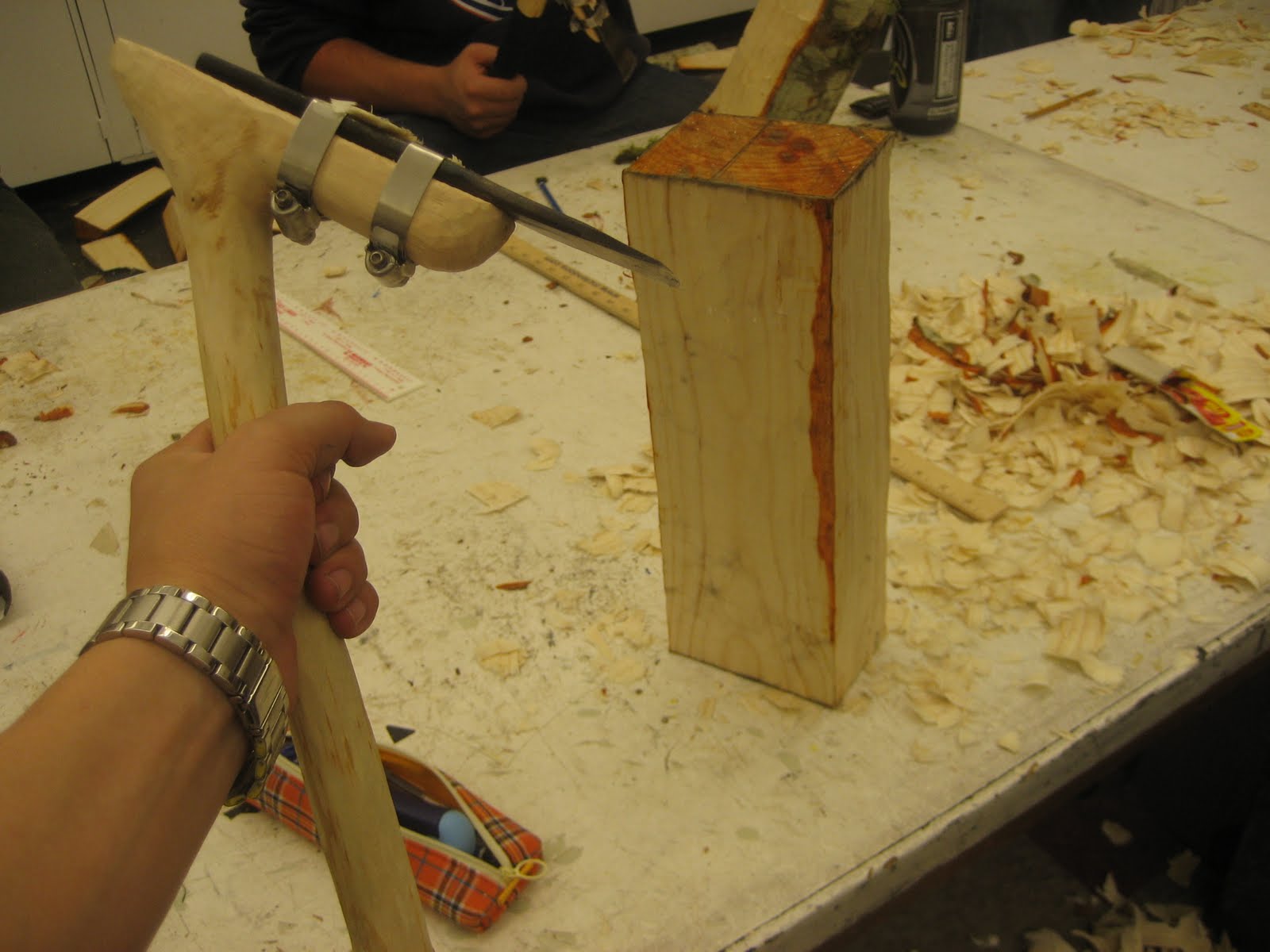
For the Wood Carving class, the first project was make an adze, a traditional wood carving tool. First we went to the Pratt Fine Arts Center and received a piece of steel that used to be a suspension strut for truck. It was cut into 6" strips and trimmed to about 1 1/2" wide. We then used a trench forge, hammer, tongs, anvil, grinders and sanders to make it a blade.
Then we were given a trimmed tree branch to make into a handle that we de-barked and shaped. Then we used hose clamps to fasten the blade to it.
From there our teacher cut down a tree (alder) and cut it into 14" tall rounds. He brought them to class where we partnered up, picked a round and used a froe (a long thin wedge attached at a right angle to a handle at one end) to split the round in half. then we took our round, measured out a rectangle on one side, and then using squares and yard sticks to transfer the rectangle to its exact mirror on the other end.
Then using the froe, we cleaved the round at the edges of our rectangle.
Then used our adze to square up the block.
We are now tracing our sketches for our ladle (our second project), on the sides and then top and bottom and using the adze to trim away the excess wood. After that, we use straight knives and crooked knives to carve from there. Its really awesome.